
TL;DR, Quick Answer
9 min readBill Gates published "Content is King" on 3 January 1996 and argued that information and entertainment, not hardware, would make the real money online. He was right about content and silent about distribution. In 2026 the rule that works is content plus distribution plus consistency: one substantial piece, adapted per platform, published on a schedule you can hold for 12 months. AdaptlyPost handles the middle part, one post fanned out to thirteen platforms with per-platform captions from a single calendar.
Every marketer has repeated the line that content is king, and almost nobody has read the essay it came from. Bill Gates published it on the Microsoft website on 3 January 1996, and his actual argument was narrower and more useful than the slogan. Content would be where the money was made online, the way it had been in broadcasting. He said nothing about how that content would reach anyone, because in 1996 there was almost nothing to compete with.
That is the half the slogan drops. This guide covers what Gates wrote, why a quality-only strategy stops working in 2026, and the three-part rule we use instead. We build AdaptlyPost, a scheduler that publishes one post to thirteen platforms, so the distribution section is where our bias lives. We say so where it matters.
The short version: content is the foundation, distribution is the multiplier, and consistency is the compounding. Spend one hour creating, ten minutes adapting for each extra platform, and an hour and a half promoting. Hold that cadence for 12 months. Most people quit in month three, which is why the ones who stay win.

Where did "content is king" come from?
"Content is King" is the title of an essay Bill Gates published on the Microsoft website on 3 January 1996. The opening sentence is the whole thesis: "Content is where I expect much of the real money will be made on the Internet, just as it was in broadcasting."
Gates compared the internet to television. Television created industries that built TV sets, he wrote, but the long-term winners were the companies that used the medium to deliver information and entertainment. He predicted the same pattern online, with software, news, games and reference material as the content, and he expected most of it to be paid for by advertising or subscription. Microsoft has since removed the essay from its published-writing page, and the original text survives in the Wayback Machine and in dozens of reprints.
Three of his points hold in 2026 without edits:
- Content is how a company talks to an audience. A product page, a tutorial video, a LinkedIn post and a newsletter are all the same job.
- Content builds trust before a sale. Gates called it the reason people would return to a site.
- Content shapes buying decisions. He expected it to be the thing people paid for, directly or through attention.
What he did not address is what happens when everyone follows his advice at once.
Why is content alone not enough in 2026?
Content alone is not enough in 2026 because the platforms that carry it decide who sees it, and they decide based on signals the content itself does not control. Three forces work against a publish-and-pray strategy.
1. Volume
YouTube states that more than 500 hours of video are uploaded to the platform every minute. Every network reports the same shape: more posts than the feed can show. A good post competes with every other thing the reader could look at in the same second, not only with rival brands.
2. Algorithms
Instagram, TikTok, LinkedIn, X and YouTube each rank posts on engagement signals, recency and format, and each one demotes posts that push the reader off-platform. A brilliant article linked from a bare tweet reaches fewer people than a mediocre native video, because the ranking system is scoring behavior, not quality. The Facebook content strategy guide walks through one platform's format preferences in detail.
3. Format
Each platform has a native shape. LinkedIn rewards document carousels, Instagram rewards Reels and carousels, X rewards threads, TikTok rewards vertical video under a minute. One piece of content pasted unchanged into all of them matches none of them. Adapting the same idea into each shape is the work most teams skip, and it is the work that decides reach.
What rule replaces "content is king"?
The rule that replaces "content is king" is content plus distribution plus consistency, and the second and third terms decide the outcome. Each part is a separate job with a separate time budget.
| Part | The job | Time per piece | What happens without it |
|---|---|---|---|
| Content | One substantial piece with a point of view | 1 hour | Nothing to distribute |
| Distribution | Adapt per platform, publish everywhere, promote | 10 minutes per platform plus 90 minutes promotion | The piece is read by whoever was already there |
| Consistency | Hold the cadence for 12 months | Ongoing | The audience never learns when to expect you |
Part 1: Content that gives the reader something in the first minute
Quality still gates everything, but the definition has moved. A piece qualifies in 2026 when the reader gets a usable takeaway inside the first paragraph, when it carries a specific opinion the reader could not get from a generic summary, and when it is structured so a skimmer and a close reader both leave with something. The content strategy guide covers how to pick the topics.
Stop producing listicles that read like every other listicle, articles written for a keyword rather than a person, and anything you would not share yourself. AI-drafted text that nobody edited fails all three tests at once.

AdaptlyPost
Start Your 7-Day Free Trial
All-platform analytics
Social Inbox
AI-powered assistant
Part 2: Distribution, the part most teams underfund
Distribution is where the ratio goes wrong. Teams spend hours on production, publish once, and promote for five minutes. The 1-10-100 rule reverses that: for every hour spent creating, spend ten minutes adapting the piece for each additional platform and 100 minutes promoting it.
Four channel types carry the work. Owned channels are the email list, the blog and the YouTube channel, and the DMA's 2019 email tracker still puts email's return at 42 to 1, the highest of any channel. Earned channels are guest posts, podcast appearances and press. Paid channels are Meta, TikTok, LinkedIn and Google ads plus newsletter sponsorships. Social channels are the amplification layer: LinkedIn for B2B, Instagram and TikTok for visual stories, X for real-time conversation, YouTube Shorts for broad short-form reach. The distribution channels guide explains how the four fit together.
This is the part AdaptlyPost is built for. One post in the composer publishes to X, LinkedIn, Instagram, Facebook, TikTok, YouTube, Pinterest, Threads, Bluesky, Mastodon, Telegram, Google Business Profile, and Tumblr, and the per-platform text override lets LinkedIn get the professional version while Instagram gets the casual one, from the same draft. The cross-posting strategy guide covers when to vary the caption and when to leave it alone.
Part 3: Consistency, the part that compounds
Consistency is not a posting schedule. It is the mechanism that turns individual posts into an asset, because platforms rank accounts that post on a rhythm, search engines index sites that publish on a rhythm, and audiences return to sources they can predict.
The realistic floor is two to four blog articles a month, three to five social posts a week per active platform, one or two newsletters a week, and one or two videos a week. Less is fine. The number that matters is the one you can hold for 12 months without burning out, because the first three months return almost nothing and most teams quit inside them.
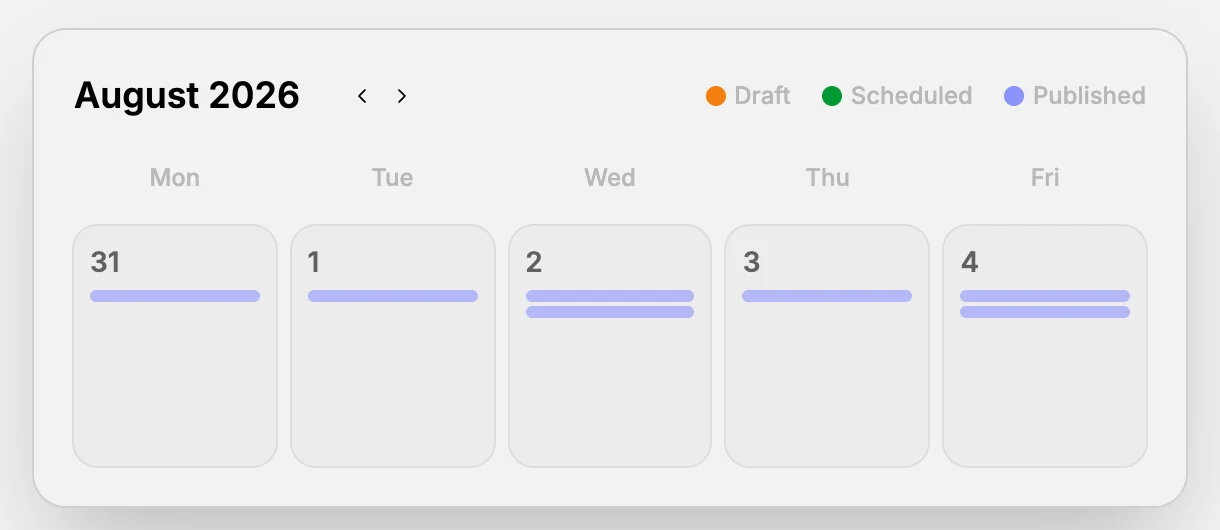
The AdaptlyPost calendar is where the cadence lives. Week and month views show every draft, scheduled and published post across the thirteen platforms, and dragging a post to a new slot reschedules it. The content calendar guide walks through building the cadence from scratch.
How do you turn one piece of content into twenty?
One substantial piece becomes twenty by atomization: breaking a 2,000-word article into the native format of each platform instead of writing twenty separate things. This is the single highest-return habit in the whole system.
A single 2,000-word article yields:
- 10 X thread starters, one per section
- 5 LinkedIn document carousels, one per framework or list
- 3 Instagram carousels built from the same slides
- 8 to 10 short vertical videos, one per takeaway
- 1 long YouTube video walking through the whole piece
- 2 newsletter editions
- 15 standalone quote graphics
- 1 podcast episode outline
The content repurposing guide shows the exact cutting process. In AdaptlyPost, the AI caption writer drafts the per-platform variants from the source text, and the Creator plan at $19 per month includes 150 AI credits for that work. Bulk scheduling then loads the whole batch onto the calendar in one pass instead of twenty.
Which content formats get reach in 2026?
Five formats get reach in 2026: short vertical video, long educational articles, LinkedIn carousels, email newsletters and user-generated content. Each one earns its place for a different reason.
- Short vertical video. TikTok, Reels and Shorts rank video above static formats. Keep it between 15 and 60 seconds, put the hook in the first three seconds, and end on one specific action.
- Long educational articles. 2,000 words or more, original data or a named framework, real screenshots and deliberate internal links. This is the format that earns search traffic for years and feeds every other format on this list.
- LinkedIn carousels. Six to ten slides, one idea per slide, a headline and almost no body text, and a call to action on the last slide. LinkedIn's feed ranks document posts well because readers dwell on them.
- Email newsletters. The only channel where the audience belongs to you and not to a ranking system. One topic per issue, a subject line that states the value, a conversational voice.
- User-generated content. Stackla's 2019 consumer survey found that 79% of respondents said user-generated content highly influenced their purchase decisions. Branded hashtags, customer spotlights and testimonial campaigns source it.
Which metrics show that content is working?
The metrics that show content is working are the ones tied to a business outcome, and follower count is not one of them. Track three groups.
Engagement depth: comments rather than likes, saves and shares, time on page, scroll depth, and replies to emails. Business impact: leads per piece, conversion rate on content-sourced visitors, acquisition cost per channel, and revenue that a CRM attributes to content. Growth: email list growth rate, organic search trend, branded search volume, and returning-visitor share. The social media analytics feature reports the per-platform engagement side of that list for every post AdaptlyPost publishes.
Where does AI fit in content marketing now?
AI fits content marketing as the drafting and adaptation layer, and fails as the strategy or the voice. Claude, ChatGPT and their peers do research, outlines, first drafts, editing passes and reformatting for each platform well. They produce interchangeable text when they are left to decide what to say.
The split that works: AI handles the mechanical stages, and a person supplies the opinion, the lived example and the final edit. The next step past drafting is letting an agent publish, and how to post to social media with AI agents shows how Claude or ChatGPT schedules the finished batch to thirteen platforms through AdaptlyPost's MCP server.
What does a 30-day content system look like?
A 30-day content system moves from audit to measurement in four weekly blocks, and each block has five concrete tasks.
AdaptlyPost
Start Your 7-Day Free Trial
All-platform analytics
Social Inbox
AI-powered assistant
Week 1, audit. Review your last 20 pieces. Pick the top five by engagement and by business result. Name the pattern behind them. Set three to five content pillars tied to a business goal. Choose two or three distribution channels to concentrate on.
Week 2, production. Build the calendar with dates and owners. Batch-produce four to eight foundation pieces. Write the repurposing plan for each one. Schedule the derivative posts across the chosen channels. Set up analytics so the results are measurable.
Week 3, distribution. Publish and promote the first two pieces. Reply to every comment and reaction. Share in relevant communities as a participant, not a billboard. Start outreach for guest and collaboration slots. Run a small paid test on the strongest piece.
Week 4, measurement. Read the data. Double the budget on what performed. Cut the bottom 20% of tactics. Adjust the pillars to what the audience responded to. Build next month's calendar from the numbers, not the gut.
Is content still king?
Content is still king in the sense Gates meant: it is where the value is created. It is not king in the sense the slogan implies, because creating value and delivering it are separate jobs, and the second one is now harder than the first.
The rule for 2026 is content plus distribution plus consistency. Ten purposeful pieces adapted for each platform and published on a rhythm beat a hundred random ones. Your point of view is the only part an AI cannot copy. Everything after that is logistics, and logistics is what a scheduler is for.
Frequently Asked Questions
Who said "content is king" and when?
Bill Gates wrote the essay "Content is King" and published it on the Microsoft website on 3 January 1996. He argued that content, meaning information and entertainment, would be where most of the real money was made on the internet, the same way it had been in broadcasting. The phrase entered marketing vocabulary within months and has stayed there for three decades.
Does content marketing still work in 2026?
Content marketing still works in 2026 when creation is paired with distribution, and it fails when a team publishes once and waits. Platforms rank on engagement, recency and native format, so the same article adapted into a LinkedIn carousel, a short video and a newsletter reaches many times the audience of the article alone. AdaptlyPost publishes those adaptations to thirteen platforms from one calendar.
How much content should you publish each week?
Publish one substantial piece per week and atomize it into 15 to 20 platform-native posts, rather than writing 20 separate things. That cadence is sustainable for the 12 months it takes content to compound, and it keeps every derivative post anchored to one point of view. Scale the volume only after the system runs without strain.
Is AI a good tool for content creation?
AI is a good tool for research, outlines, first drafts, editing and reformatting a piece for each platform, and a poor tool for deciding what to say. Text published straight from a model reads like every other model's output and erodes trust. Keep the opinion, the examples and the final edit human, and let AI and AI agents handle the mechanical and publishing stages.
Should you focus on SEO content or social media content?
Focus on both, in that order: write the long SEO piece first, then atomize it into social posts that send readers back to it. SEO content compounds over months and years through search. Social content earns immediate engagement and drives the traffic. One 2,000-word article is the source for the carousels, videos and threads that feed the social side.
How long does content marketing take to show results?
Content marketing shows first traction in three to six months and meaningful business results in 12 to 24 months. The early months build the index of published work with little visible return, which is why most teams stop inside the first quarter. The teams that hold a fixed cadence through month six are the ones that see the curve bend.
Was This Article Helpful?
Let us know what you think!
See us more often in Google
One click marks AdaptlyPost as a preferred source, so our articles sit higher in your Top Stories, AI Mode, and AI Overviews.
Before you go...
AdaptlyPost
Schedule your content across all platforms
Manage all your social media accounts in one place with AdaptlyPost.
All-platform analytics
Social Inbox
AI-powered assistant
Related Articles
How to Repurpose Content Across Channels: 8 Proven Methods
Publishing once wastes most of the work. How to repurpose content across channels with eight methods, and the adaptation rules that stop it feeling lazy.
Key Insights - Optimal Number of Hashtags Instagram 2024
Thirty is allowed but rarely works. Why the optimal number of hashtags for Instagram posts sits at five to fifteen, and how to choose which ones.
Useful Context - Effective Social Media Strategy Examples
Most plans are decorated posting schedules. Ten effective social media strategy examples with a purpose behind each, from UGC pipelines to local playbooks.