
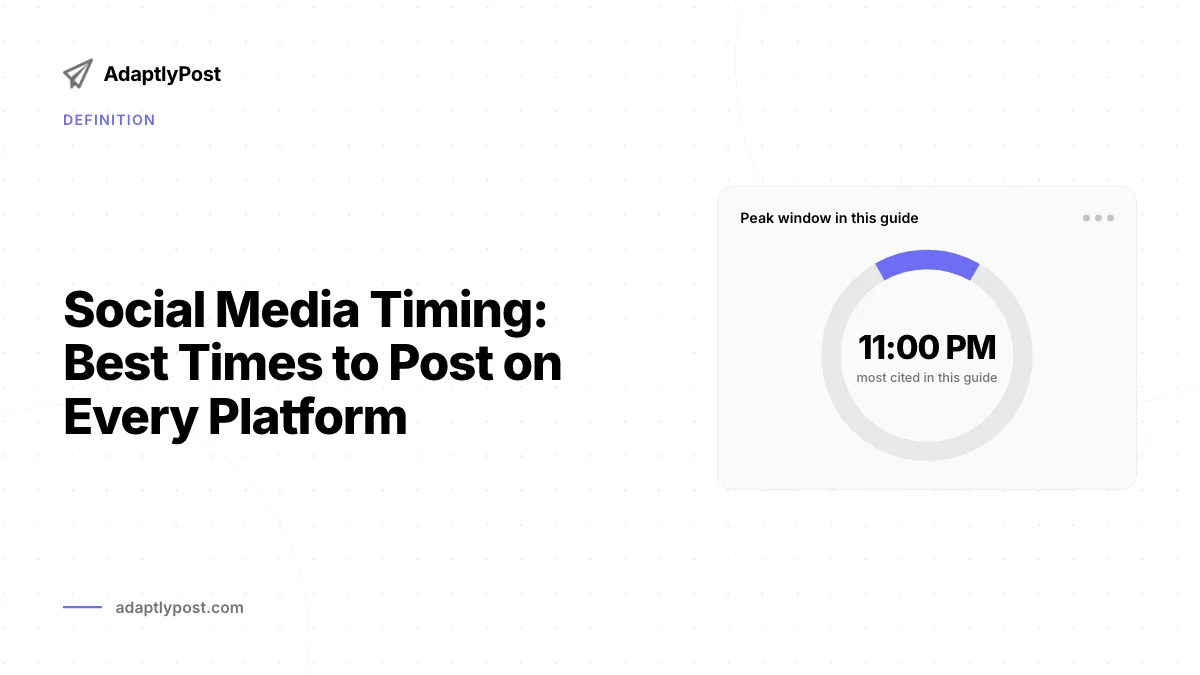
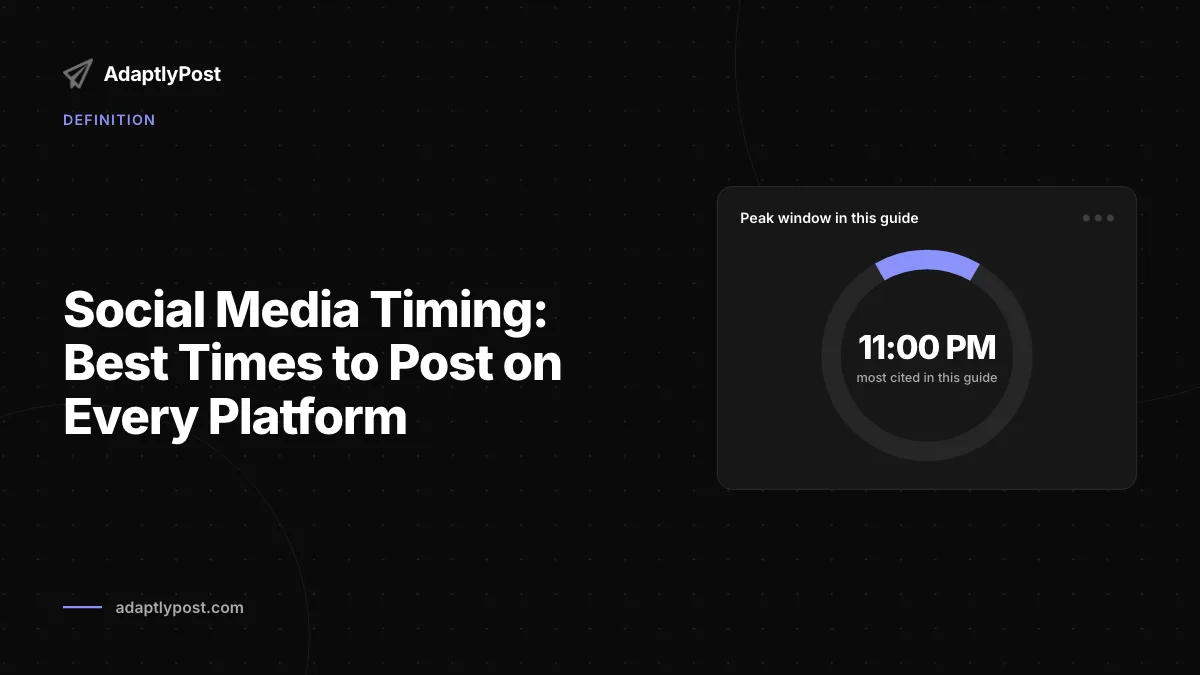
TL;DR, Quick Answer
5 min readSocial media timing refers to strategically scheduling your posts for when your target audience is most active, which significantly impacts engagement, reach, and content performance.
What Is Social Media Timing?
Publishing when your audience is awake is only half of it, because social media timing feeds the early-engagement signals algorithms use to decide reach. Because social media algorithms factor in early engagement signals when deciding how widely to distribute content, the timing of your posts directly influences how many people see and interact with them.
A well-timed post reaches more of your audience during their active hours, generates stronger early engagement, and receives broader algorithmic distribution as a result. A poorly timed post may be equally good in quality but reach a fraction of the audience simply because it was published when few people were online.
- Reaches more of the audience while they are online
- Generates stronger early engagement
- Gets broader algorithmic distribution
- Same quality, same content
- Reaches a fraction of the audience
- Fewer people online to engage early
Why Timing Matters
Algorithmic Impact
Most social media algorithms evaluate early engagement signals to determine content quality and distribution. Posts that receive rapid engagement in the first minutes and hours after publishing are more likely to be shown to additional users. Posting when your audience is active gives your content the best chance of generating these critical early interactions.

Audience Attention
Your audience's attention is finite and time-bound. During peak activity periods, more of your followers are scrolling their feeds and available to see your content. During off-peak hours, your posts compete with fewer active users available to engage.
Content Lifecycle
Social media content has a limited lifespan. A tweet's effective life is measured in minutes to hours. An Instagram post peaks within hours. Timing your content to coincide with high-activity periods maximizes the value of each post during its active window.
General Best Times to Post by Platform
These are broad guidelines based on aggregated data. Your specific audience may differ significantly.
| Platform | Best Days | Peak Times (Local) | Avoid |
|---|---|---|---|
| Tuesday-Thursday | 9-11 AM, 7-9 PM | Late night (11 PM - 5 AM) | |
| Tuesday-Friday | 9-11 AM, 1-3 PM | Weekends typically lower | |
| Twitter/X | Tuesday-Thursday | 8-10 AM, 12-1 PM | Late evening |
| Tuesday-Thursday | 7-9 AM, 12 PM, 5-6 PM | Weekends | |
| TikTok | Tuesday-Thursday | 7-9 AM, 12-3 PM, 7-11 PM | Early morning (2-5 AM) |
| Saturday-Sunday | 8-11 PM | Weekday mornings |
How to Find Your Best Posting Times

Step 1: Analyze Your Analytics
Every major platform provides data on when your followers are most active. Instagram Insights shows follower activity by day and hour. Facebook Insights provides similar data. Use this platform-specific data as your starting point.
Step 2: Review Historical Performance
Look at your past posts and identify patterns. Which posting times consistently generate the highest engagement? Sort your top-performing posts by publish time and look for clusters.
Step 3: Consider Your Audience
Think about your audience's daily routine. B2B audiences are most active during business hours. Consumer audiences peak during commuting times, lunch breaks, and evening leisure hours. International audiences require consideration of multiple time zones.
Step 4: Test Systematically
Run controlled tests by publishing similar content at different times over several weeks. Track engagement rates for each time slot to identify your optimal windows. Change only one variable at a time for reliable results.
Step 5: Refine Continuously
Audience behavior shifts with seasons, cultural events, platform changes, and evolving habits. Revisit your timing analysis quarterly to ensure your schedule remains optimized.
Timing Factors Beyond Time of Day
Day of Week
Performance varies by day. B2B content performs best Tuesday through Thursday. Consumer content peaks on weekends when leisure browsing increases.
Seasonal Patterns
Engagement patterns shift with seasons, holidays, and cultural events. Plan for increased activity during major holidays and adjust your schedule during traditionally slower periods.

AdaptlyPost
Start Your 7-Day Free Trial
All-platform analytics
Social Inbox
AI-powered assistant
Platform Updates
When platforms release new features or update their algorithms, engagement patterns can shift temporarily. Stay aware of platform changes and adjust timing accordingly.
Competitive Timing
If your competitors consistently post at the same times, consider whether publishing at slightly different times reduces competition for attention.
Content Type
Different content types perform best at different times. Educational content works well during business hours, while entertainment content peaks during evening leisure time.
Common Timing Mistakes
- Relying solely on generic best-time data. Universal recommendations are starting points, not final answers. Your audience is unique.
- Posting at the same time every day. Varying your schedule slightly can help you reach different segments of your audience who are active at different times.
- Ignoring time zones. If your audience spans multiple time zones, you may need to publish the same content at different times or find a compromise window.
- Prioritizing timing over content quality. Perfect timing cannot save poor content. Focus on quality first, then optimize timing.
- Setting and forgetting. Audience behavior changes. A posting schedule established a year ago may not reflect current patterns.
Frequently Asked Questions
Is there really a "best" time to post on social media?
There is no universal best time that applies to every account. The best time for your account depends on your specific audience, their time zone, their habits, and the platform. Use your own analytics data to determine your optimal posting times.
How many times should I post per day?
Posting frequency varies by platform. On Twitter/X, multiple daily posts are common. On Instagram and Facebook, one to two posts per day is typical. On LinkedIn, one post per business day is generally sufficient. Quality should always take priority over quantity.
Does posting at night hurt my engagement?
Not necessarily. If your audience is active at night, posting then can be effective. Many consumer brands see strong evening engagement. The key is matching your posting time to your specific audience's activity patterns, not following generic assumptions.
Should I schedule posts or publish manually?
Scheduling puts your posts out at optimal times even when you are not available to post manually. It also enables better planning and consistency. Most social media professionals use scheduling tools for the majority of their content.
How quickly after posting does timing matter?
The first 30-60 minutes after posting are the most critical for most platforms. Strong early engagement during this window significantly influences how widely the algorithm distributes your content.
Does timing outweigh content quality?
Timing cannot rescue a weak post. The post notes that perfect timing cannot save poor content, so quality has to come first. Once the content is strong, a good posting window helps it reach more people and pick up early engagement faster.
How often should I revisit my posting schedule?
Audience behavior shifts with seasons, cultural events, platform changes, and habits, so a schedule that worked a year ago may no longer fit. Revisit your timing analysis quarterly to keep it aligned with how your audience behaves now. Treat it as an ongoing check rather than a one-time setup.
Is it better to post at the same time every day?
Not always. Posting at the exact same time daily means you consistently miss audience segments who are active at other hours. Varying your schedule slightly lets you reach different segments of your audience across the week.
What is the best time to post on LinkedIn?
For LinkedIn, the best days are Tuesday through Thursday, with peak windows around 7-9 AM, 12 PM, and 5-6 PM local time. Weekends are generally the times to avoid on this platform. These are broad guidelines, so check your own analytics to confirm they hold for your audience.
What should I do if my audience spans multiple time zones?
Ignoring time zones is one of the most common timing mistakes. If your audience spans multiple time zones, you may need to publish the same content at different times or settle on a compromise window that works reasonably well for most of them. International audiences add this extra layer of planning beyond a single local peak time.
Optimize Your Posting Schedule with AdaptlyPost
AdaptlyPost makes it easy to schedule your content at the perfect times for your audience. Plan your posts in advance, publish across platforms at optimal times, and track how timing affects your performance, all from one intuitive dashboard.
Put this into practice with AdaptlyPost
Was This Article Helpful?
Let us know what you think!
See us more often in Google
One click marks AdaptlyPost as a preferred source, so our articles sit higher in your Top Stories, AI Mode, and AI Overviews.
Before you go...
AdaptlyPost
Schedule your content across all platforms
Manage all your social media accounts in one place with AdaptlyPost.
All-platform analytics
Social Inbox
AI-powered assistant
Related Glossary Terms
Make AI Content Creation Work With Human Judgment
Treat AI content creation as a drafting tool and it saves hours. Where it works for social, the guardrails that protect brand voice, and what to fact-check.
Useful Context - Site Audience Analysis
Guessing who you are talking to wastes budget. What site audience analysis covers, the tools that supply the data, and how it sharpens content.
Explained Clearly - Batching Means
Context switching is the real cost. What batching means in practice, which tasks group well together, and how one session can cover a whole month.
Related Articles
Useful Context - Content Marketing Processes
Earning attention rather than interrupting for it. Which content marketing processes make a strategy repeatable, from planning through to distribution.
Key Insights - Content Pillars Definition Marketing
Three to five recurring themes hold a calendar together. What is a content pillar in practice, how to choose yours, and examples drawn by industry.
Key Insights - Content Management Planning
What gets made, when it ships, and on which channel. Where content management planning sits between strategy and creation, and how to run it weekly.