
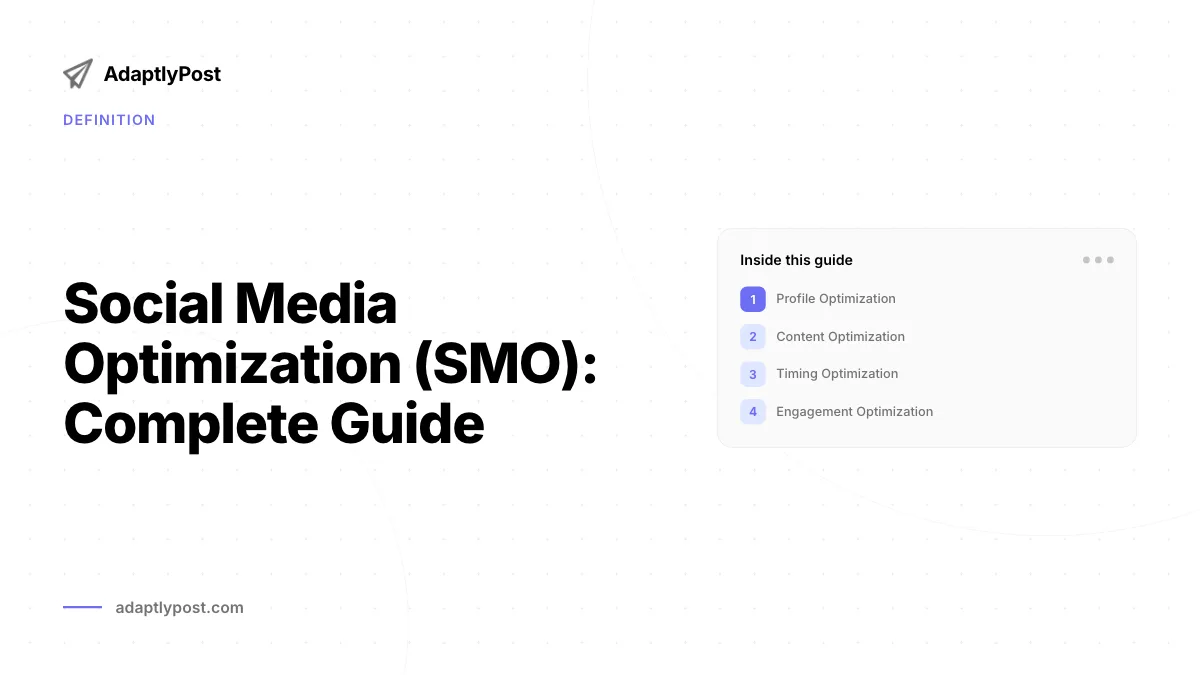
TL;DR, Quick Answer
5 min readSocial media optimization (SMO) is the strategic process of improving your social media profiles, content, and activity to maximize visibility, engagement, and traffic from social platforms.
What Is Social Media Optimization?
Tightening profiles, content, posting rhythm, and engagement habits is what social media optimization covers, and each pulls a different lever. It involves optimizing your profiles, content, posting strategies, and audience engagement techniques to increase visibility, drive more traffic, and generate higher engagement across social platforms.
SMO draws parallels with search engine optimization (SEO). Where SEO optimizes content for search engines, SMO optimizes content for social media platforms and their algorithms. Both disciplines aim to increase visibility and drive traffic, but they operate in different environments with different rules.
Why Social Media Optimization Matters
Most brands are active on social media, but few systematically optimize their presence. The difference between a casual social media presence and an optimized one shows up in reach, engagement, and business results.
Optimization matters because:
- Algorithms reward optimized content with greater distribution
- Optimized profiles convert more visitors into followers
- Strategic posting increases engagement compared to random scheduling
- Consistent optimization compounds results over time
- Better social performance supports SEO through increased signals and traffic
- Random posting schedule
- Profiles left unoptimized
- Engagement handled reactively
- Algorithms reward optimized content with greater distribution
- Optimized profiles convert more visitors into followers
- Strategic posting increases engagement over random scheduling
- Consistent optimization compounds results over time
Key Areas of Social Media Optimization
Profile Optimization
| Element | Optimization Tactic |
|---|---|
| Username/Handle | Keep it consistent across platforms and easy to search |
| Profile photo | Use a high-quality, recognizable image (logo for brands) |
| Bio/Description | Include relevant keywords, value proposition, and CTA |
| Link | Use a trackable link to your most important page |
| Pinned post | Feature your strongest, most relevant content |
| Highlights (Instagram) | Organize important content into clear categories |

Content Optimization
Format selection. Each platform favors certain content formats. Optimize by creating content in the formats that each platform's algorithm prioritizes, whether that is reels on Instagram, short videos on TikTok, or documents on LinkedIn.
Caption optimization. Write captions that hook readers in the first line, provide value in the body, and include a clear call to action. Front-load key information since most platforms truncate captions after a few lines.
Hashtag strategy. Research and use a mix of high-volume, medium-volume, and niche hashtags relevant to your content and audience. Avoid banned or irrelevant hashtags that can limit your reach.
Visual quality. Invest in high-quality visuals that align with platform dimensions and aesthetics. Properly sized, well-designed visuals perform significantly better than generic or poorly formatted ones.
Timing Optimization
Publish content when your specific audience is most active. Analyze your platform analytics to identify peak engagement windows. Test different posting times and track results to refine your schedule.
Engagement Optimization
Respond to comments quickly, especially in the first hour after posting. Engage proactively with your audience's content. Create content that naturally encourages conversation, such as questions, polls, and opinion-based posts.
SMO and SEO: The Connection
Social media optimization and search engine optimization are complementary strategies. While social signals (likes, shares, comments) are not direct ranking factors for most search engines, the relationship between SMO and SEO is significant.
Strong social media performance drives traffic to your website, which search engines do track. Widely shared content earns backlinks from people who discover it through social channels. Social profiles themselves rank in search results, providing additional search visibility for your brand. And social platforms increasingly function as search engines themselves, particularly for younger demographics.
SMO Best Practices
- Audit your profiles regularly. Outdated information, broken links, and inconsistent branding undermine your optimization efforts.
- Test and iterate. Optimization is not a one-time task. Continuously test content formats, posting times, caption styles, and engagement tactics.
- Use analytics data to guide decisions. Base your optimization on actual performance data rather than assumptions or best practices alone.
- Optimize for each platform individually. What works on Instagram may not work on LinkedIn. Customize your approach for each platform's unique characteristics.
- Make sharing easy. Add social sharing buttons to your website content, ensure your site's social meta tags are properly configured, and create content designed to be shared.
- Focus on quality over quantity. Posting less often with highly optimized content typically outperforms posting frequently with unoptimized content.

Measuring SMO Success
Track improvements in key metrics after implementing optimization changes. Compare engagement rates, reach, click-through rates, and follower growth before and after optimization efforts. Look for trends over weeks and months rather than evaluating individual posts.

AdaptlyPost
Start Your 7-Day Free Trial
All-platform analytics
Social Inbox
AI-powered assistant
Frequently Asked Questions
What is the difference between SMO and SMM?
Social media optimization (SMO) focuses on improving and refining your social media presence for better performance. Social media marketing (SMM) is the broader practice of using social media to market your business, which includes SMO as one component alongside content creation, advertising, and community management.
How long does it take to see results from SMO?
Profile optimizations can show immediate improvements in follower conversion rates. Content optimization typically shows measurable results within 4-8 weeks of consistent implementation. Overall SMO is an ongoing process that compounds over time.
Is SMO only for large businesses?
No. SMO principles apply to any social media presence regardless of size. In fact, smaller accounts often see proportionally larger improvements from optimization because they are starting from a less optimized baseline.
Can I optimize my social media without paid tools?
Yes. Platform-native analytics provide the data needed for most optimization decisions. Free scheduling tools, image editors, and hashtag research tools can support your efforts without requiring paid subscriptions.
How often should I optimize my social media?
Profile audits should happen quarterly. Content optimization should be continuous, with regular testing and refinement. Timing optimization should be reviewed monthly as audience behavior patterns shift.
Does SMO improve my search engine rankings?
Social signals like likes, shares, and comments are not direct ranking factors for most search engines. But SMO supports SEO indirectly: it drives traffic to your website, earns backlinks from people who discover shared content on social channels, and helps your social profiles rank in search results.
What should an optimized social media bio include?
An optimized bio includes relevant keywords, a clear value proposition, and a call to action. Pair it with a trackable link to your most important page and a pinned post that features your strongest content.
Why does response speed matter after I post?
Responding to comments quickly, especially within the first hour, signals to the platform's algorithm that your content is generating conversation. Engaging proactively with your audience and creating content that invites questions, polls, or opinions reinforces that signal.
What undermines an otherwise optimized profile?
Outdated information, broken links, and inconsistent branding undermine your optimization efforts even when the rest of your profile is dialed in. Regular profile audits catch these issues before they cost you conversions.
Which content formats should I use on each platform?
Match the format to what each platform's algorithm favors: reels on Instagram, short videos on TikTok, and documents on LinkedIn. Content built in the format a platform prioritizes gets a better shot at distribution.
Optimize Your Social Media with AdaptlyPost
AdaptlyPost provides the tools you need to optimize every aspect of your social media presence. Schedule content at optimal times, analyze performance data, and manage your profiles across platforms from one centralized dashboard.
Put this into practice with AdaptlyPost
Was This Article Helpful?
Let us know what you think!
See us more often in Google
One click marks AdaptlyPost as a preferred source, so our articles sit higher in your Top Stories, AI Mode, and AI Overviews.
Before you go...
AdaptlyPost
Schedule your content across all platforms
Manage all your social media accounts in one place with AdaptlyPost.
All-platform analytics
Social Inbox
AI-powered assistant
Related Glossary Terms


Make AI Content Creation Work With Human Judgment
Treat AI content creation as a drafting tool and it saves hours. Where it works for social, the guardrails that protect brand voice, and what to fact-check.
Useful Context - Site Audience Analysis
Guessing who you are talking to wastes budget. What site audience analysis covers, the tools that supply the data, and how it sharpens content.
Explained Clearly - Batching Means
Context switching is the real cost. What batching means in practice, which tasks group well together, and how one session can cover a whole month.
Related Articles
Useful Context - Content Marketing Processes
Earning attention rather than interrupting for it. Which content marketing processes make a strategy repeatable, from planning through to distribution.
Key Insights - Content Pillars Definition Marketing
Three to five recurring themes hold a calendar together. What is a content pillar in practice, how to choose yours, and examples drawn by industry.
Key Insights - Content Management Planning
What gets made, when it ships, and on which channel. Where content management planning sits between strategy and creation, and how to run it weekly.