
TL;DR, Quick Answer
6 min readUser activation is the moment when a new user experiences the core value of your product or platform for the first time. Improving activation rates is one of the most impactful ways to drive growth and retention.
What Is User Activation?
The moment a new signup completes the action that proves the product works for them is user activation. In a scheduler that action is a first post queued; on a social platform it is a first account followed.
Activation is distinct from sign-up. A user who creates an account but never takes a meaningful action has signed up but has not been activated. The gap between sign-up and activation is where many products lose potential long-term users, making it one of the most critical stages in the user journey.
- Created an account
- No meaningful action taken
- Likely to drift away
- Completed the core action
- Experienced real product value
- Far more likely to stay, pay, or engage
Why User Activation Matters
Activation sits at the heart of the growth funnel. Users who reach the activation milestone are dramatically more likely to become retained, paying, or regularly engaged users compared to those who sign up and drift away.
Consider these implications:
- Retention depends on activation. Users who never experience your product's value have no reason to return. Improving activation directly improves retention rates.
- Acquisition costs are wasted without activation. Every marketing dollar spent acquiring a user who never activates is essentially lost. Boosting activation rates increases the return on your customer acquisition efforts.
- Activation reveals product-market fit. If activation rates are low despite healthy sign-up numbers, it may indicate that your onboarding is confusing, your value proposition is unclear, or the product itself needs improvement.

How to Define Your Activation Metric
The right activation metric depends on your product and what constitutes a genuine "aha moment" for your users. Here are examples across different contexts:
| Product Type | Possible Activation Metric |
|---|---|
| Social media scheduler | Scheduled and published first post |
| Social network | Connected with 5 friends |
| Video platform | Watched 3 videos |
| E-commerce | Completed first purchase |
| Analytics tool | Connected a data source |
To find your activation metric, analyze the behavior of your most engaged long-term users and look for common early actions they took. The action that most strongly correlates with long-term retention is typically your best activation metric.
Strategies to Improve User Activation
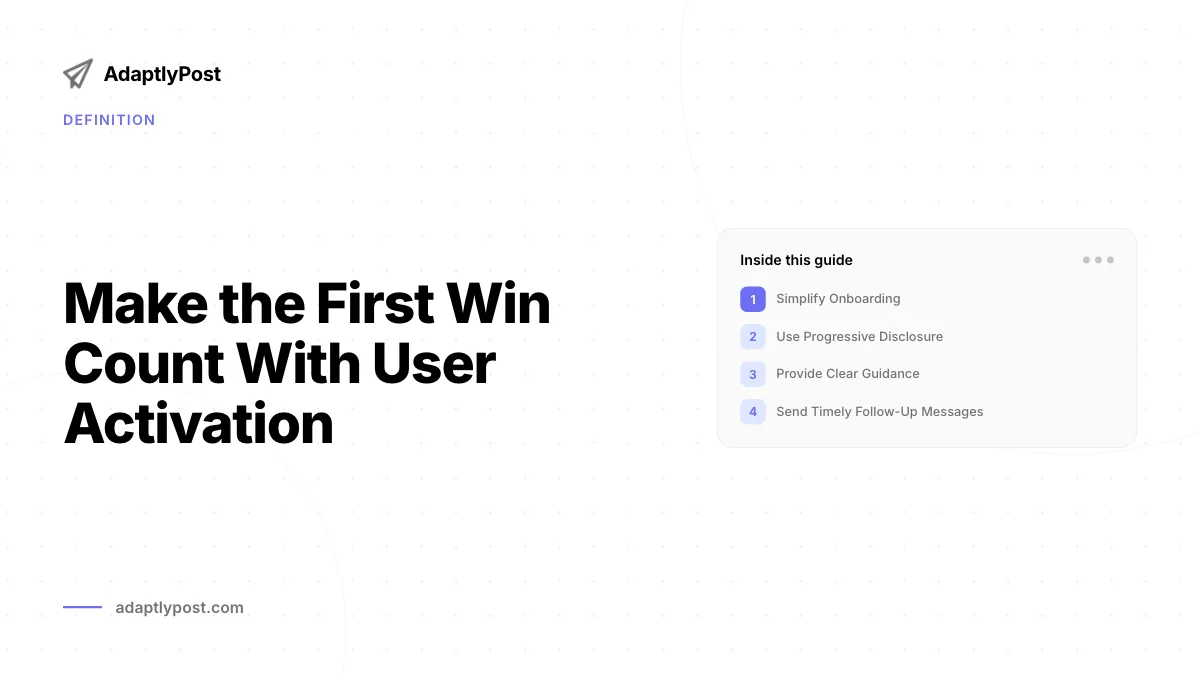
Simplify Onboarding
Remove unnecessary steps from your sign-up and onboarding flow. Every additional field, screen, or decision point creates friction that reduces the chance a user will reach activation. Guide new users directly toward the core action that delivers value.
Use Progressive Disclosure
Do not overwhelm new users with every feature at once. Introduce functionality gradually, starting with the essentials needed to reach activation. Advanced features can be introduced later once the user is engaged and comfortable.
Provide Clear Guidance
Checklists, tooltips, and guided tours help users understand what to do next. A simple onboarding checklist showing three to five steps to get started gives new users a clear path forward and a sense of progress as they complete each item.

Send Timely Follow-Up Messages
If a user signs up but does not complete activation within a reasonable timeframe, send targeted emails or in-app messages. These messages should focus on the value the user is missing and provide a direct path back to the activation action.
Reduce Time to Value
The faster a user experiences value, the more likely they are to activate. If your product requires complex setup before a user sees any benefit, look for ways to provide a quick win early in the process, even if the full setup takes longer.
Measuring User Activation
Track your activation rate as a percentage: the number of users who complete the activation action divided by the total number of new sign-ups over the same period. Monitor this metric weekly or monthly and segment it by acquisition channel, user type, and other relevant dimensions.
A/B testing different onboarding flows, messaging, and feature introductions is the most reliable way to improve your activation rate over time. Small improvements in activation can compound into significant gains in retention and revenue.

AdaptlyPost
Start Your 7-Day Free Trial
All-platform analytics
Social Inbox
AI-powered assistant
User Activation in Social Media Marketing
The concept of activation applies to social media audiences as well. When someone follows your brand account, they have "signed up" but are not yet activated. Activation in this context means they have engaged meaningfully with your content, whether by commenting, sharing, clicking a link, or taking an action you prompted.
Building content that encourages early engagement from new followers helps activate your social media audience and increases the chance they will continue interacting with your brand over time.
What is the difference between user activation and user engagement?
Activation is a one-time milestone that marks the moment a user first experiences core value. Engagement is the ongoing pattern of interaction that follows activation. Activation happens once; engagement is continuous.
How do I find my product's activation metric?
Analyze cohorts of retained users versus churned users. Identify the early actions that retained users took at significantly higher rates. The action with the strongest correlation to long-term retention is your best activation metric candidate.
What is a good user activation rate?
Activation rates vary widely by industry and product type. SaaS products commonly see activation rates between 20 and 40 percent. The key is not hitting a universal benchmark but improving your own rate consistently over time.
Can you have multiple activation metrics?
Some products define a primary activation metric and secondary milestones. However, having too many activation metrics can dilute focus. Start with one clearly defined metric and expand only when you have a strong reason to do so.
Activate Your Social Media Audience with AdaptlyPost
AdaptlyPost creates and schedules content that turns passive followers into engaged community members. By planning consistent, valuable content across platforms, you can improve audience activation and build a loyal following that drives real business results.
Frequently Asked Questions
What counts as activation for a social media scheduler?
For a scheduler, the table in this guide lists it as the moment a user schedules and publishes a first post. That single action shows they got real value out of the product rather than just poking around the interface. It is a concrete, easy to measure version of the "aha moment" every activation metric is trying to capture.
What does activation mean for a social network?
A social network's activation metric is typically connecting with five friends, according to the examples in this guide. Reaching that number signals the user built a network within the platform instead of showing up once and leaving. Video platforms use a similar logic, with three videos watched as the marker of engagement taking hold.
Why is acquisition spend wasted without activation?
Every marketing dollar spent bringing in a user who never activates is essentially lost, since that user never experiences the product's value. Activation converts an expensive click into someone who sticks around, pays, or refers others. Raising your activation rate is one of the most direct ways to increase the return on your customer acquisition efforts.
What does a low activation rate next to healthy sign-ups usually mean?
A low activation rate next to healthy sign-ups points to onboarding that confuses users, a value proposition that is not landing, or a product experience that needs work. Sign-ups measure interest, not whether the product delivered on that interest. Activation is the number that tells you whether people who showed up actually found what they came for.
What is a good example activation metric for an analytics tool?
Connecting a data source is the activation metric for analytics tools. That action means the user moved past setup and got the product pointed at their real data. It parallels e-commerce, where the equivalent moment is completing a first purchase.
How many steps should an onboarding checklist have?
A simple checklist showing three to five steps works best. That range gives new users a clear path and a sense of progress as they check items off, without turning onboarding into a chore. Checklists, tooltips, and guided tours all serve the same purpose: telling users exactly what to do next.
What should follow-up messages to unactivated users focus on?
Follow-up messages should focus on the value the user is missing and give a direct path back to the activation action. A generic reminder email misses the point. The message needs to reconnect the user with the specific benefit they signed up for and make the next step obvious.
Why does reducing time to value help activation?
The faster someone experiences value, the more likely they are to activate, since long setup periods give users more chances to give up. If a product needs a complex setup before showing any benefit, a quick early win keeps people engaged while the fuller setup finishes in the background. Time to value is one of the more direct levers available for improving activation.
AdaptlyPost
Start Your 7-Day Free Trial
All-platform analytics
Social Inbox
AI-powered assistant
How often should you track your activation rate?
Weekly or monthly, segmented by acquisition channel, user type, and other relevant dimensions. Tracking it on a set cadence, rather than checking in occasionally, is what makes small onboarding improvements visible before they compound into real retention gains.
What does activation mean for a social media audience?
A new follower has "signed up" the same way a new account sign-up has. Activation comes when they engage meaningfully by commenting, sharing, clicking a link, or taking a prompted action. Content built to encourage that early engagement is what turns a passive follower into someone likely to keep interacting with the brand.
Was This Article Helpful?
Let us know what you think!
See us more often in Google
One click marks AdaptlyPost as a preferred source, so our articles sit higher in your Top Stories, AI Mode, and AI Overviews.
Before you go...
AdaptlyPost
Schedule your content across all platforms
Manage all your social media accounts in one place with AdaptlyPost.
All-platform analytics
Social Inbox
AI-powered assistant
Related Glossary Terms


Choose Top Analytics Metrics Across the Funnel
Awareness, engagement, and conversion numbers rarely tell one story. A metrics analysis example showing which figures to pair and which to ignore.
Useful Context - Site Audience Analysis
Guessing who you are talking to wastes budget. What site audience analysis covers, the tools that supply the data, and how it sharpens content.
A Practical Overview - B2C Social Commerce Platform
Business-to-Consumer means selling directly to individuals, and a B2C social commerce platform is where that now happens: feed, checkout, and all.
Related Articles


Explained Clearly - Body Copy
Headlines earn the click; body copy earns the action. How to structure it for ads and social, keep it scannable, and cut it down without losing the argument.

Turn Recognition Into Demand by Building Brand Awareness
Recognition sits at one end, top-of-mind at the other. How brand awareness is built on social, which metrics track it, and what actually moves them.


Turn Records Into Insight With Audience Data Enrichment
Adding fields to records you already hold. What audience data enrichment covers, the sources worth trusting, and how it sharpens segments and targeting.