
TL;DR, Quick Answer
6 min readThought leadership is the practice of establishing yourself or your brand as a trusted authority in your industry by sharing original insights, expertise, and perspectives. It drives trust, visibility, and business growth.
What Is Thought Leadership?
Positioning yourself as an authoritative source of ideas within a field is what thought leadership means, and it demands original thinking rather than curation. A thought leader does not simply share existing knowledge; they contribute original thinking, challenge conventional wisdom, and shape the conversation in their field.
On social media, thought leadership is expressed through consistent publication of valuable content that demonstrates deep expertise, unique perspective, and genuine commitment to advancing the conversation in your industry.
Why Thought Leadership Matters
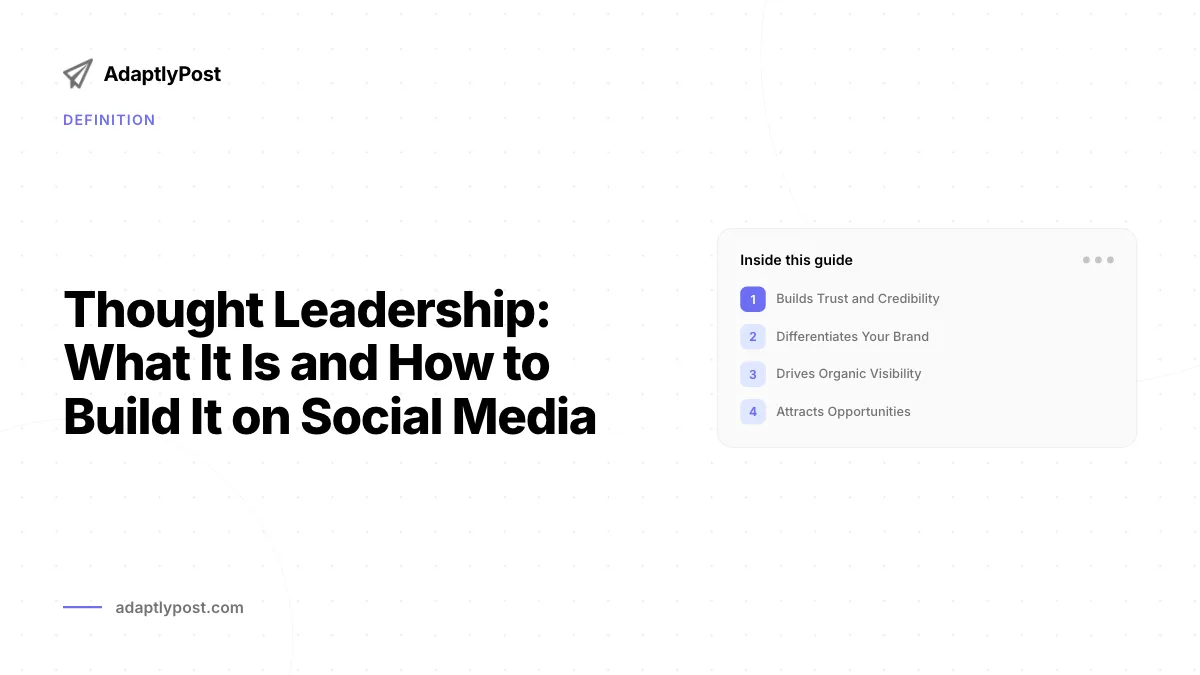
Builds Trust and Credibility
When you consistently share valuable insights, your audience comes to view you as a reliable source of information. This trust translates into business opportunities, whether that means attracting clients, securing partnerships, or commanding premium pricing.
Differentiates Your Brand
In crowded markets, thought leadership sets you apart from competitors who simply promote their products. By leading the conversation, you become the brand people think of first when they need expertise in your area.
Drives Organic Visibility
Thought leadership content is inherently shareable. When people find genuine value in your perspectives, they share it with their networks, amplifying your reach without paid promotion.

Attracts Opportunities
Thought leaders attract speaking invitations, media features, partnership proposals, and talent. Being recognized as an authority opens doors that marketing budgets alone cannot.
- Promote products instead of ideas
- Blend into a crowded market
- Depend on paid promotion for reach
- Wait for opportunities to come to them
- Become the trusted source people turn to
- Become the brand people think of first
- Get shared organically without paid promotion
- Attract speaking invitations, media features, and partnerships
How to Build Thought Leadership on Social Media
Define Your Niche
You cannot be a thought leader in everything. Choose a specific area where you have genuine expertise, passion, and a unique perspective. The narrower your focus, the easier it is to stand out.
Develop Original Perspectives
Thought leadership requires original thinking. This means going beyond restating common knowledge. Analyze trends, share lessons from your experience, challenge assumptions, and connect ideas in ways others have not.
Choose the Right Platforms
Select platforms where your target audience consumes professional content. LinkedIn is the most natural fit for B2B thought leadership. Twitter/X works well for real-time industry commentary. YouTube and podcasting support long-form thought leadership content.

Create Consistently
Thought leadership is built through sustained effort, not a single viral post. Develop a publishing cadence you can maintain long-term. Quality and consistency together build the kind of recognition that positions you as a leader.
Engage with Your Community
Thought leadership is not a one-way broadcast. Engage with comments on your posts, participate in discussions on others' content, and build relationships with peers in your space.
Thought Leadership Content Types
| Content Type | Description | Best Platform |
|---|---|---|
| Industry Analysis | Breaking down trends and implications | LinkedIn, Blog |
| Experience Sharing | Lessons learned from real situations | LinkedIn, Twitter/X |
| Data-Driven Insights | Original research or data interpretation | LinkedIn, Twitter/X, Blog |
| Contrarian Takes | Challenging popular assumptions | Twitter/X, LinkedIn |
| Predictions | Forecasting industry direction | LinkedIn, YouTube, Blog |
| Frameworks | Original models or processes | LinkedIn, Blog, Carousel |
| Case Studies | Detailed examples with results | LinkedIn, Blog |
| Interviews/Discussions | Conversations with other experts | YouTube, Podcast, Twitter Spaces |
Common Thought Leadership Mistakes
Prioritizing quantity over quality. Publishing mediocre content frequently does not build thought leadership. It is better to share one genuinely insightful piece per week than daily posts that add nothing new to the conversation.
Being too self-promotional. If your "thought leadership" is just product marketing in disguise, audiences will tune out. Lead with value and let your expertise speak for itself.

AdaptlyPost
Start Your 7-Day Free Trial
All-platform analytics
Social Inbox
AI-powered assistant
Avoiding strong opinions. Thought leaders take positions. Vague, non-committal content that tries to please everyone does not establish authority. Be willing to have a point of view.
Inconsistency. Thought leadership requires showing up regularly. Publishing intensively for a month and then going silent for three months undermines the consistency that builds recognition.
Ignoring feedback and engagement. Thought leadership is a conversation. Leaders who do not respond to comments, questions, and critiques miss opportunities to deepen connections and refine their thinking.
Measuring Thought Leadership Impact
Direct measurement of thought leadership can be challenging, but these indicators signal progress:
- Growth in followers and connections within your target audience
- Increase in inbound inquiries from potential clients or partners
- Invitations to speak at events, join panels, or contribute to publications
- Mentions and citations of your content by others in your industry
- Engagement rates on your thought leadership content
- Media features and interview requests
Related Terms
- Social Proof - How thought leadership builds credibility signals
- Strategy Planning - Integrating thought leadership into your overall strategy
- Social Selling - Using thought leadership to support sales
- Text Thread - A popular format for thought leadership content
Frequently Asked Questions
How long does it take to become a recognized thought leader?
Building genuine thought leadership typically takes one to three years of consistent effort. The timeline depends on your starting credibility, the competitiveness of your niche, and the quality and frequency of your content.
Can a company be a thought leader, or is it only for individuals?
Both individuals and companies can establish thought leadership. Company thought leadership often works best when it is championed by specific people within the organization, such as founders, executives, or subject matter experts, who serve as the face of the brand's expertise.
Do I need to be an expert to be a thought leader?
You need genuine expertise and experience in your area. However, you do not need to be the world's foremost authority. Sharing your unique perspective, learning journey, and practical experience can be just as valuable as academic credentials.
What is the difference between thought leadership and content marketing?
Content marketing is a broader strategy that includes all types of content created to attract and engage an audience. Thought leadership is a specific type of content marketing focused on sharing original insights and establishing authority. All thought leadership is content, but not all content is thought leadership.
How often should I publish thought leadership content?
There's no fixed schedule, but consistency matters more than volume. One genuinely insightful post a week builds more authority than daily posts that add nothing new to the conversation. Pick a cadence you can sustain long-term rather than publishing intensely for a month and going quiet for the next three.
Which social platform works best for thought leadership?
LinkedIn is the most natural fit for B2B thought leadership, Twitter/X works well for real-time industry commentary, and YouTube or podcasting suit long-form content. Choose the platform where your target audience already consumes professional content.
How can I tell if my thought leadership is working?
Watch for growth in followers and connections within your target audience, along with inbound inquiries from potential clients or partners. Speaking invitations, media features, and mentions of your content by others in your industry are also strong signals. Engagement rates on your posts round out the picture.
What's the biggest thought leadership mistake to avoid?
Being too self-promotional is one of the fastest ways to lose an audience. If your posts are just product marketing dressed up as insight, people tune out. Lead with value first and let your expertise speak for itself.
Should thought leadership content include personal opinions?
Yes, thought leaders take positions instead of hedging. Vague, non-committal content that tries to please everyone doesn't establish authority. Be willing to state a clear point of view, even when it's contrarian.
What types of content count as thought leadership?
Industry analysis, experience sharing, data-driven insights, contrarian takes, predictions, frameworks, case studies, and interviews with other experts all qualify. What ties them together is original thinking rather than restating what's already known. The right format depends on the platform: LinkedIn and blog posts suit analysis and frameworks, while Twitter/X fits contrarian takes and quick commentary.
Share Your Expertise with AdaptlyPost
Consistent publishing is the foundation of thought leadership. AdaptlyPost makes it easy to plan, schedule, and distribute your thought leadership content across all your social platforms, helping you maintain the consistency that builds authority over time.
AdaptlyPost
Start Your 7-Day Free Trial
All-platform analytics
Social Inbox
AI-powered assistant
Was This Article Helpful?
Let us know what you think!
See us more often in Google
One click marks AdaptlyPost as a preferred source, so our articles sit higher in your Top Stories, AI Mode, and AI Overviews.
Before you go...
AdaptlyPost
Schedule your content across all platforms
Manage all your social media accounts in one place with AdaptlyPost.
All-platform analytics
Social Inbox
AI-powered assistant
Related Glossary Terms


Make AI Content Creation Work With Human Judgment
Treat AI content creation as a drafting tool and it saves hours. Where it works for social, the guardrails that protect brand voice, and what to fact-check.
Useful Context - Site Audience Analysis
Guessing who you are talking to wastes budget. What site audience analysis covers, the tools that supply the data, and how it sharpens content.

Explained Clearly - Batching Means
Context switching is the real cost. What batching means in practice, which tasks group well together, and how one session can cover a whole month.
Related Articles
Useful Context - Content Marketing Processes
Earning attention rather than interrupting for it. Which content marketing processes make a strategy repeatable, from planning through to distribution.

Key Insights - Content Pillars Definition Marketing
Three to five recurring themes hold a calendar together. What is a content pillar in practice, how to choose yours, and examples drawn by industry.


Key Insights - Content Management Planning
What gets made, when it ships, and on which channel. Where content management planning sits between strategy and creation, and how to run it weekly.