
TL;DR, Quick Answer
5 min readSocial media signals are the engagement metrics from social platforms, such as likes, shares, and comments, that search engines may use as indirect indicators of content quality and relevance.
What Are Social Media Signals?
Google has said repeatedly that likes and shares are not ranking factors, so social signals and SEO connect indirectly. Distribution earns links, brand searches, and the engagement patterns that genuinely do move rankings.
In the context of search engine optimization, social media signals are discussed as potential factors that influence how search engines evaluate and rank web content. The relationship between social signals and search rankings has been debated extensively in the SEO community.
How Social Media Signals Relate to SEO
The relationship between social signals and search rankings is indirect rather than direct. Major search engines, including Google, have stated that social signals are not direct ranking factors. However, the activities that generate strong social signals also produce outcomes that search engines do value.
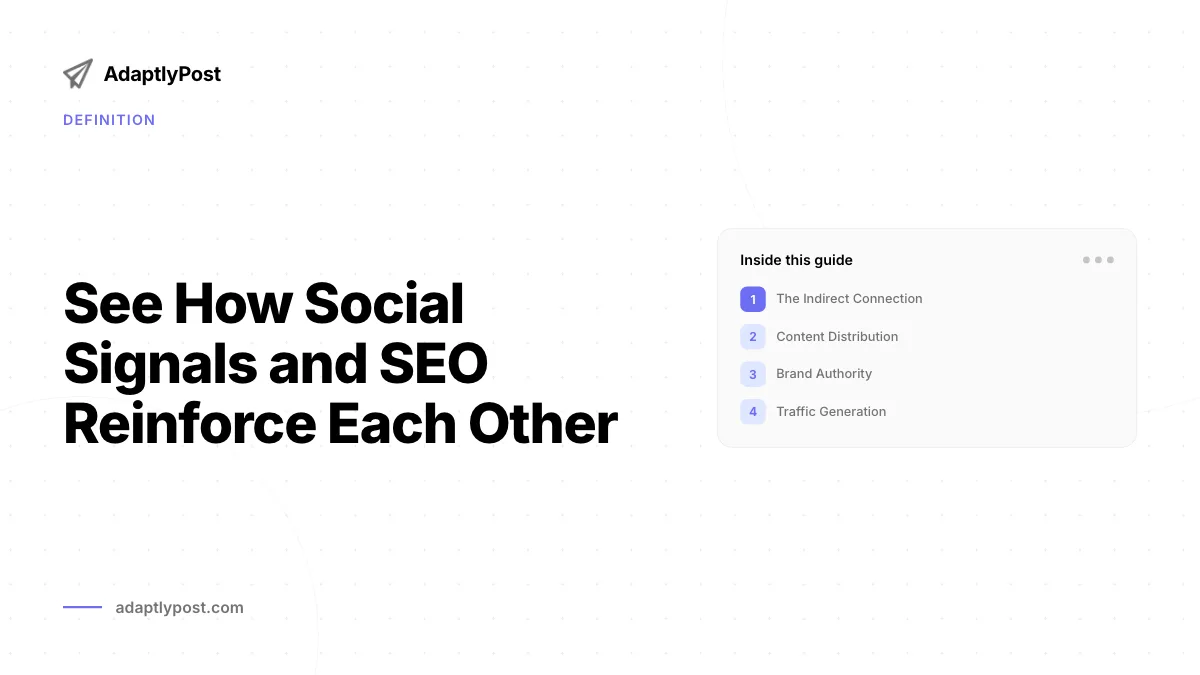
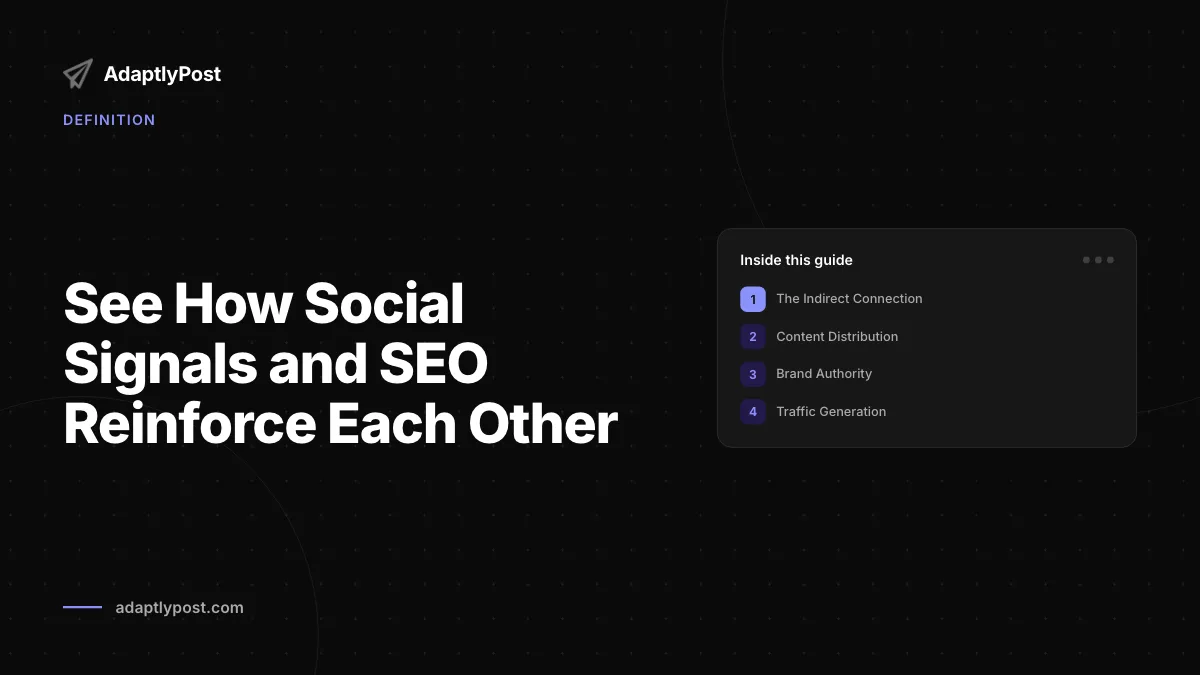
The Indirect Connection
| Social Activity | SEO-Related Outcome |
|---|---|
| Content shared widely on social media | More people see it, increasing the chance someone links to it from their website |
| High engagement on social posts | Drives traffic to your website, which search engines can measure |
| Brand mentions on social platforms | Increase branded search volume, which signals brand authority |
| Social profiles ranking in search | Additional search real estate for your brand |
| Social media driving content discovery | Accelerates indexing of new content |
- Likes
- Shares
- Comments
- Links earned through distribution
- Branded search volume
- Engagement patterns search engines can measure
Why Social Media Signals Matter

Content Distribution
Social media serves as a powerful distribution channel for your content. When content is shared across social platforms, it reaches audiences who then link to it, reference it, or create their own content about it. These downstream actions directly influence SEO.
Brand Authority
A strong social media presence with consistent engagement signals to both users and search engines that your brand is active, credible, and valued by its audience. This contributes to overall brand authority, which search engines consider when evaluating content trustworthiness.
Traffic Generation
Social media drives referral traffic to your website. While traffic itself is debated as a ranking factor, the behavioral signals generated by that traffic, such as time on site, pages per session, and bounce rate, can influence how search engines perceive your content quality.
Faster Indexing
Search engine bots monitor social platforms for new content and URLs. Widely shared content is discovered and indexed more quickly than content that relies solely on traditional crawling.
Types of Social Media Signals
Engagement Signals
Likes, comments, reactions, and other direct interactions with your content. These indicate that real people find your content valuable enough to respond to.
Sharing Signals
Shares, retweets, reposts, and pins represent the strongest social signals because they indicate that someone found your content valuable enough to distribute to their own audience.
Profile Signals
The completeness, consistency, and authority of your social media profiles themselves. Well-maintained profiles with substantial followings signal organizational credibility.
Mention Signals
When your brand or content is mentioned by others on social media, even without a direct link, it contributes to your online presence and discoverability.
How to Strengthen Your Social Media Signals
Create Link-Worthy Content
The most effective social signals come from content that people genuinely want to share. Focus on creating comprehensive, original, and valuable content that stands out in your niche.
Make Sharing Easy
Include social sharing buttons on your website content. Pre-populate sharing text with compelling copy. Ensure your pages have properly configured Open Graph tags so shared links display attractively on social platforms.
Build an Engaged Audience
A large, engaged social following amplifies every piece of content you share. Invest in community building, respond to your audience, and maintain consistent engagement.

AdaptlyPost
Start Your 7-Day Free Trial
All-platform analytics
Social Inbox
AI-powered assistant
Encourage Employee Advocacy
Your team members' social networks extend your reach significantly. Create employee advocacy programs that make it easy for staff to share company content.

Diversify Across Platforms
Signals from multiple platforms carry more weight than signals from a single platform. Maintain an active presence across the platforms most relevant to your audience.
Synchronize Content and Social Strategies
Align your content marketing and social media strategies so that every piece of content receives appropriate social promotion. New blog posts, resources, and tools should have a coordinated social launch plan.
Measuring Social Signal Impact
Directly measuring the SEO impact of social signals is difficult because the relationship is indirect. However, you can track correlations:
- Monitor how social sharing of specific content correlates with backlink acquisition
- Track whether socially promoted content gets indexed faster
- Compare organic search traffic trends with social engagement trends
- Measure branded search volume alongside social media activity levels
Frequently Asked Questions
Are social signals a Google ranking factor?
Google has publicly stated that social signals are not direct ranking factors. However, the activities that generate strong social signals, such as earning backlinks, driving traffic, and building brand recognition, do influence rankings. The relationship is indirect but meaningful.
Which social platform generates the strongest SEO signals?
No single platform dominates. The most impactful platform depends on your industry and audience. Content shared on platforms where your target audience is active and creates their own content in response will generate the most SEO-relevant outcomes.
Can buying social engagement improve my SEO?
No. Purchased engagement (fake likes, bot followers, paid shares) does not generate the downstream SEO benefits that come from genuine social activity. Search engines have become sophisticated at distinguishing organic from artificial signals.
How long does it take for social signals to impact SEO?
The impact is gradual and indirect. Content that gains social traction sees backlinks accumulate over weeks or months. Traffic patterns driven by social activity influence SEO over similar timeframes. There is no instant cause-and-effect relationship.
Should I focus more on social media or SEO?
Social media and SEO are complementary strategies, not competing ones. Social media drives content distribution and brand awareness, while SEO captures search intent. The strongest digital presence combines both, with each strategy reinforcing the other.
What are Open Graph tags used for in social sharing?
Open Graph tags are meta tags that control how a shared link looks on social platforms, including the title, image, and description shown in the preview. Pages without them often display broken or ugly links, which cuts down on shares. Configuring them properly makes content more shareable, and shares are one of the pathways that leads to backlinks.
Does social media traffic affect SEO rankings directly?
Not directly. Traffic itself is debated as a ranking factor, but the behavior that traffic produces, such as time on site, pages per session, and bounce rate, gives search engines something to measure. Social media is one of the channels that sends that traffic in the first place.
Why do social media profiles show up in Google search results?
Social profiles can rank in search results on their own, giving your brand extra search real estate beyond your website. Well-maintained profiles with a substantial following also signal organizational credibility to anyone who finds them. That credibility feeds into the broader picture search engines use to judge brand authority.
What is the difference between engagement signals and sharing signals?
Engagement signals are direct reactions such as likes, comments, and reactions, showing that people found the content worth a response. Sharing signals are shares, retweets, reposts, and pins, and they carry more weight because someone chose to distribute the content to their own audience. That distribution is what produces backlinks and other outcomes search engines value.
Does employee advocacy help SEO?
Employee advocacy does not change rankings by itself, but it extends how far content travels. Team members' social networks reach people a company account alone would not, and more people seeing the content raises the odds that someone links to it. That is the same distribution-to-backlink path that makes other social sharing valuable for SEO.
AdaptlyPost
Start Your 7-Day Free Trial
All-platform analytics
Social Inbox
AI-powered assistant
Strengthen Your Social Signals with AdaptlyPost
Consistent, engaging social media activity generates the signals that support your broader digital strategy. AdaptlyPost maintains a strong social presence across platforms by scheduling content, tracking engagement, and keeping your brand active and visible.
Put this into practice with AdaptlyPost
Was This Article Helpful?
Let us know what you think!
See us more often in Google
One click marks AdaptlyPost as a preferred source, so our articles sit higher in your Top Stories, AI Mode, and AI Overviews.
Before you go...
AdaptlyPost
Schedule your content across all platforms
Manage all your social media accounts in one place with AdaptlyPost.
All-platform analytics
Social Inbox
AI-powered assistant
Related Glossary Terms
Direct Traffic Meaning: What It Is and Why It Matters
Learn what direct traffic means in analytics, what causes it, how to interpret it accurately, and why it matters for your marketing strategy.
Instagram Reels SEO Optimization: How to Rank and Get Discovered
Instagram behaves like a search engine now. Which ranking factors Instagram reels SEO optimization touches, from caption keywords to on-screen text.

YMYL Meaning: Your Money or Your Life Pages Explained
Your Money or Your Life pages face stricter quality standards. The YMYL meaning, what qualifies as one, and why it touches social content too.
Related Articles


Make AI Content Creation Work With Human Judgment
Treat AI content creation as a drafting tool and it saves hours. Where it works for social, the guardrails that protect brand voice, and what to fact-check.

Choose Top Analytics Metrics Across the Funnel
Awareness, engagement, and conversion numbers rarely tell one story. A metrics analysis example showing which figures to pair and which to ignore.
Learn When to Archive Social Media Data Instead of Deleting
Archiving hides a post without erasing it. How to archive social media data on Instagram, Facebook, X, LinkedIn, and TikTok, and how to restore it later.